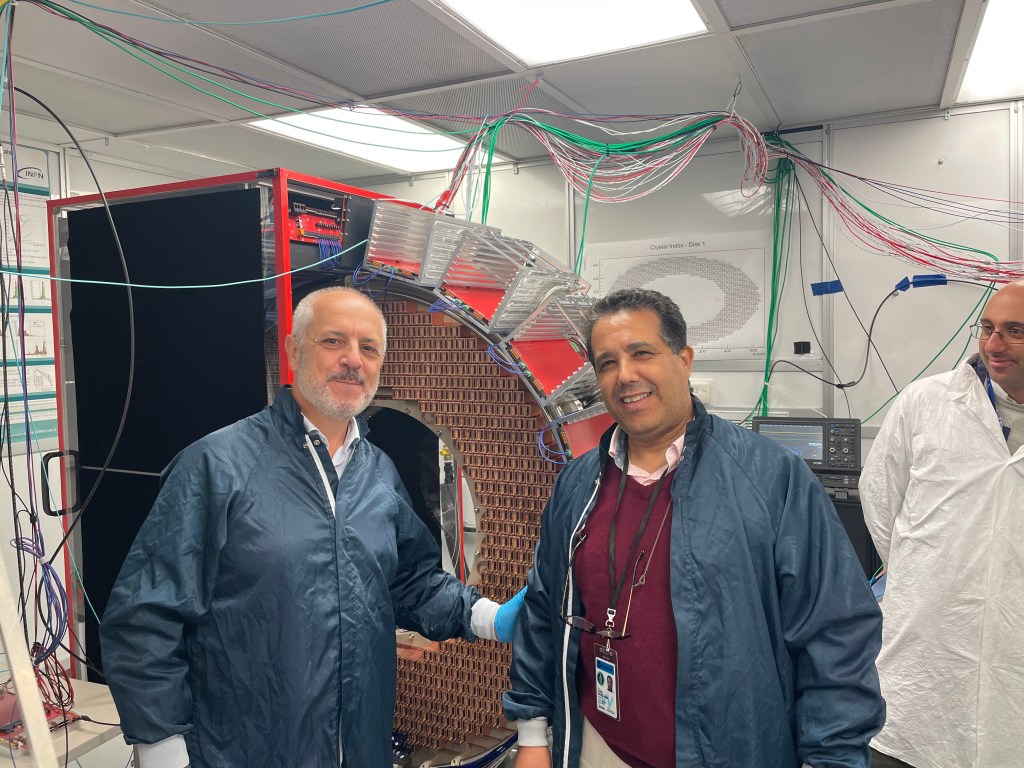
Prof. Kamal Benslama and Prof. Stefano Miscetti (Mu2e Co-Spokesperson,)
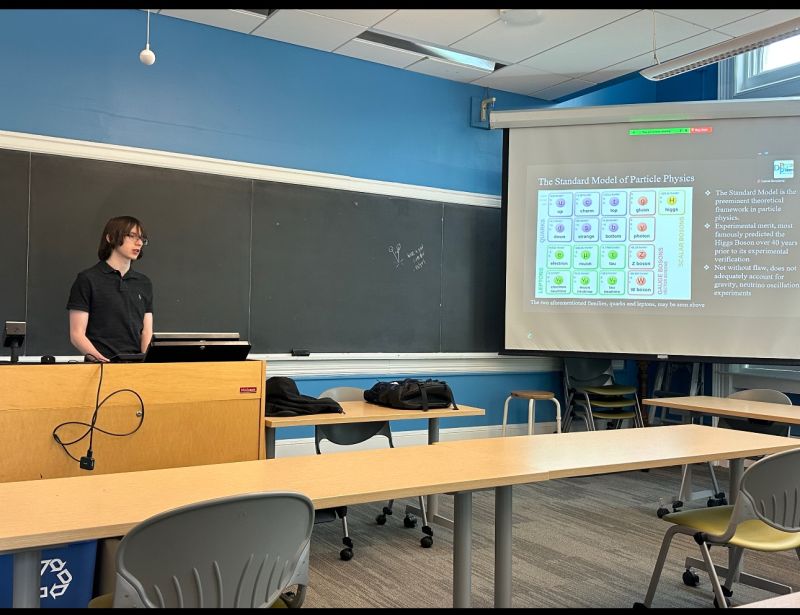
Graduate Student: Brendan Mullany.
Particle Physics at Drew
The Drew particle physics group is a member of the Mu2e collaboration at Fermilab, the international DUNE experiment, and the ProtoDUNE experiment at CERN.
Mu2e consists of over 200 members representing institutions in the United States, Italy, the UK, Russia and Germany. Physicists, undergraduate and graduate students, engineers, technicians and computing professionals at all levels of their careers are involved in this project. The collaboration is responsible for building and operating the experimental apparatus and analyzing the resulting data.
𝐃𝐔𝐍𝐄 is a next-generation, international neutrino experiment with a near detector at Fermilab and enormous far detectors located deep underground at the Sanford Underground Research Facility. It aims to send a high-intensity neutrino beam across Earth to study fundamental mysteries — neutrino oscillations, neutrino mass ordering, CP violation in the lepton sector, and potentially rare phenomena like proton decay or neutrinos from supernovae.
𝐏𝐫𝐨𝐭𝐨𝐃𝐔𝐍𝐄 is a large-scale prototype detector built at CERN using liquid argon and time-projection chamber technology; it has successfully demonstrated the feasibility, stability, and performance of detector designs intended for DUNE, validating crucial design and calibration techniques.
The DUNE and ProtoDUNE Experiments
Drew works on the photon detection system of ProtoDUNE Vertical Drift, the prototype at CERN for DUNE’s far detectors. When a charged particle crosses the liquid argon it leaves both ionisation charge and a prompt flash of scintillation light. The light arrives first, which is what tells the experiment when an event happened, and that timing is what makes the charge information usable.
The light is collected by X-ARAPUCA modules mounted on the cathode and on the cryostat membrane, read out by silicon photomultipliers and digitised by the DAPHNE electronics. A single run produces millions of waveforms across hundreds of channels.
Our work is on knowing which of those channels can be trusted. We develop an end-to-end detector-health analysis that ingests each run, extracts per-channel features, reads the calibration, and classifies how every channel is behaving, then publishes the outcome to a monitoring site that updates as new runs arrive. The methods behind that classification are described under artificial intelligence and particle physics below.
Because the pipeline is configuration-driven, pointing it at a different detector is a change to a configuration file rather than to the code.
The Mu2e Experiment
The goal of the Mu2e experiment is to find evidence that a muon—a fundamental subatomic particle and one of the most basic building blocks of the universe—can change into an electron and nothing else.
Observing muon-to-electron conversion would be a major discovery and would signal the existence of new particles or new forces of nature. It could also point physicists toward a single theory explaining the genetics of the particles born in the Big Bang. Discovering this is central to understanding what physics lies beyond the Standard Model.
Drew responsibilities on Mu2e
Our group is involved in several research projects:
- Development of the online data quality monitoring system of the Mu2e experiment
- Development of a data quality flag system for the experiment
- Development of an Online Muon-Stopping Rate Monitoring system Using the LYSO Crystals
- Particle Identification and Muon Rejection using machine learning and Artificial Intelligence.
- Commissioning, Operation and Maintenance of the experiment
- Physics Analysis using machine learning and Artificial Intelligence
- General service to the Mu2e collaboration and the particle physics community in the US
- Development of the collaboration’s shift scheduling platform
- Analysis of the muon to electron conversion channel
Of these, Professor Benslama is personally responsible for the online data quality monitoring system and for the shift scheduling platform.
Artificial intelligence and particle physics
Modern particle physics experiments record more data than anyone can inspect by hand. Our group builds the software that reads it, and uses machine learning where it does something a simpler method cannot. The tools are written to be general from the start. An algorithm developed for one detector should carry over to the next one through a configuration file rather than a rewrite.
Finding the channels that are failing
A photon detection system has hundreds of channels and millions of recorded waveforms per run. Most are healthy. Deciding which are not is an anomaly detection problem.
We run two independent judgements side by side. The first is a set of data-driven cuts, derived per module from the spread of the channels themselves rather than from fixed thresholds. The second is unsupervised: an autoencoder learns what a normal channel looks like, and an isolation forest flags the ones that do not fit. We report both and we do not merge them into one verdict. Where the two disagree is exactly where a person should look.
Measuring whether the learning helped
An anomaly detector nobody has tested is a guess. We manufacture faults and inject them into real data so that the truth is known, then score both methods against it on efficiency and false positive rate. We also check whether a model trained on one module still works on another. A detector-health model that only works on the detector it was trained on has not learned a method, it has memorised a detector.
Knowing when not to use it
Not every problem needs a network. Our conversion-electron search is built deliberately from explicit selection criteria rather than a trained classifier, so that every cut can be defended and its systematic uncertainty estimated. Keeping the simple version also gives an honest baseline. It is the only way to say what a learned method actually bought.
Frameworks meant to be reused
Thresholds, feature lists, time windows and detector geometry live in configuration, never in the source. That is what makes the same framework portable between detectors and between experiments. We treat the framework as a result in its own right, not just the plot it produced.
Fair shift scheduling for collaborations
A large experiment has to staff its control room around the clock, and the people who do it come from dozens of institutions, each owing a share of the work. Deciding who sits which shift is a scheduling problem, but it is also a fairness problem, and the second part is what makes it hard.
Within Mu2e, Professor Benslama is responsible for developing the collaboration’s shift platform. It inverts the usual approach. Instead of assigning people to slots, it collects ranked wishes from individuals, allocates seats under each institution’s quota, and then offers those seats to people who accept or decline. Nobody is placed on a shift they never agreed to. Rule checking is kept separate from allocation, so a schedule is validated against every constraint before it is published rather than trusted because the algorithm produced it. The principle is that the platform proposes, never assigns, and proves that it kept the rules.
Fairness is measured rather than asserted. The system tracks the shifts nobody wants, overnight, weekends and holidays, and reports how those are spread across institutions instead of leaving it to goodwill. On a synthetic collaboration of 48 institutions and 256 members it filled 70 to 72 of the 72 seats in each period with no rule violations, and after a simulated year most institutions sat within 13 percent of their cumulative fair share.
The method is not specific to particle physics. It applies to any collaboration that staffs a facility in blocks of shifts under institutional quotas.
Kamal Benslama, “Proposing, never assigning: fair allocation of control-room shifts in experimental particle physics collaborations from ranked wishes under institutional quotas,” arXiv:2609.19658 (2026).
Research Opportunities
All students interested in particle physics are welcome to contact Professor Benslama to inquire about research opportunities with the Drew Particle Physics Group (DPPG).
 Drew Particle Physics Group (DPPG)